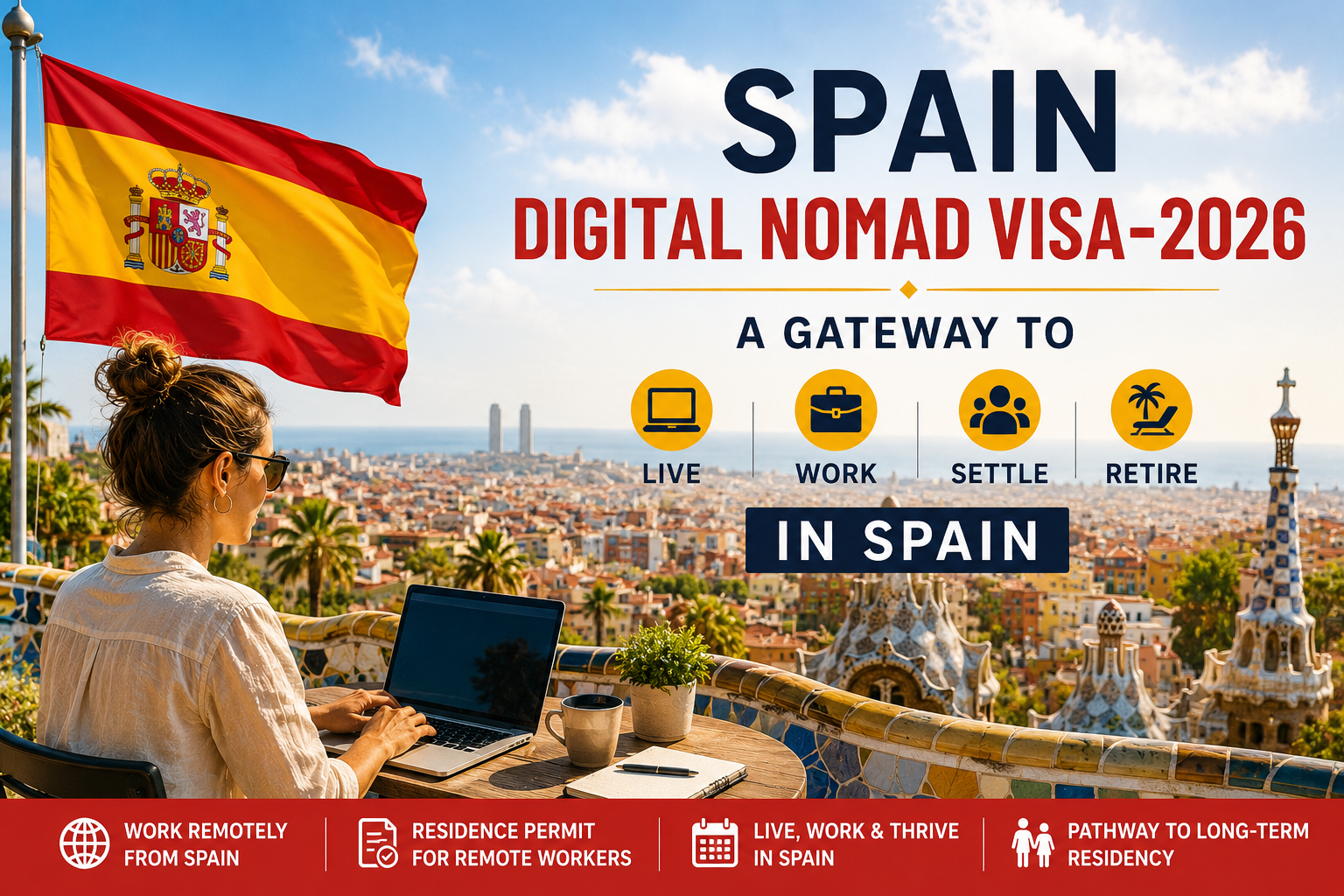
Spain’s Digital Nomad Visa, introduced under the Startup Act, continues in 2026 to attract remote professionals from around the world seeking a legal pathway to live in Europe while working for foreign employers or clients. With its strong lifestyle appeal, relatively accessible income requirements, and long-term residency benefits, Spain has positioned itself as one of the most competitive destinations for digital nomads, freelancers, and remote workers.
What is the Spain Digital Nomad Visa?
The Spain Digital Nomad Visa allows non-EU/EEA citizens to live in Spain while working remotely for companies or clients located outside the country. It is designed for:
- Remote employees of foreign companies
- Freelancers with international clients
- Self-employed professionals offering digital services globally
The visa is part of Spain’s broader effort to attract global talent and strengthen its innovation-driven economy.
Importantly, it also provides a clear pathway from temporary residence to long-term settlement and eventually permanent residency and citizenship.
Why Spain is Becoming a Global Remote Work Hub
Spain continues to stand out as one of Europe’s most attractive destinations for remote workers due to a combination of lifestyle and policy advantages:
- High quality of life and healthcare system
- Warm climate and Mediterranean lifestyle
- Strong internet infrastructure in major cities
- Affordable living compared to other Western European countries
- Large international expat and digital nomad communities
- Excellent travel connectivity within Europe
Cities such as Barcelona, Madrid, Valencia, Málaga, and Alicante are among the most popular hubs for remote professionals.
Income Requirements 2026 Update
To qualify for the Spain Digital Nomad Visa, applicants must demonstrate stable monthly income from foreign sources.
As of 2026, the general requirement is:
- Around €2,200–€2,600 per month for a single applicant
- Additional income required for dependents (typically 75% for a spouse and 25% per child)
- Applicants must show consistent earnings through:
- Employment contracts
- Freelance agreements
- Bank statements and tax documentation
Compared to other EU digital nomad programs, Spain’s threshold remains relatively moderate, making it accessible for mid-level remote professionals.
Key Eligibility Requirements
To apply for the Spain Digital Nomad Visa, applicants must typically meet the following conditions:
- Be a non-EU/EEA/Swiss citizen
- Have a university degree or at least 3 years of professional experience
- Work remotely for a foreign company or clients outside Spain
- Provide proof of stable income
- Have private health insurance valid in Spain
- No serious criminal record
- Proof of accommodation in Spain
Applicants can apply either from their home country (consulate route) or directly from Spain if legally present.
Tax Benefits for Digital Nomads
One of Spain’s most attractive features is its special tax regime for incoming remote workers, often referred to as the “Beckham Law” extension for digital nomads.
Eligible visa holders may benefit from:
- Reduced flat tax rate (around 24% on Spanish-sourced income up to a limit)
- Potential tax advantages for a period of up to 5–6 years
- Avoidance of full global income taxation in early years (depending on conditions)
However, taxation depends on individual circumstances, and professional tax advice is strongly recommended.
Duration and Renewal
The Spain Digital Nomad Visa typically follows this structure:
- Initial visa: 1 year (if applied from abroad)
- Residence permit: Up to 3 years (if applied in Spain)
- Renewable for an additional 2 years
After 5 years of legal residence, applicants may qualify for permanent residency, and after 10 years, they may become eligible for Spanish citizenship, subject to legal requirements.
A Pathway to Long-Term Settlement
Unlike short-term remote work permits, Spain’s visa offers a structured long-term future:
- Temporary residence →
- Renewable residence permits →
- Permanent residency →
- Citizenship (for eligible applicants)
This makes Spain one of the few EU countries offering a complete lifecycle option: live, work, settle, and retire.
Lifestyle Advantage: Why Nomads Stay Long-Term
Beyond legal benefits, Spain’s lifestyle plays a major role in long-term settlement decisions:
- Affordable Mediterranean diet and culture
- Strong social life and outdoor lifestyle
- Excellent public transport in major cities
- Beaches, mountains, and cultural heritage
- Family-friendly environment and safety
For many remote professionals, Spain evolves from a temporary base into a long-term home.
The Spain Digital Nomad Visa in 2026 remains one of Europe’s most attractive remote work residency programs. With moderate income requirements, strong tax incentives, and a clear pathway to permanent residency and citizenship, Spain offers more than just a visa—it offers a long-term lifestyle transition.
For digital professionals seeking stability, mobility, and quality of life, Spain continues to represent a powerful opportunity to live, work, settle, and eventually retire in Europe.